
By mid-November on the Island, most of us are spending more time indoors. The mornings are dark, the rain is back, and the walk to the car is about the only movement some people get before sitting down for eight hours. By January, a lot of those people show up at the clinic saying they feel “stiff” and can’t figure out why.
Usually there’s no single cause. Joints and muscles tend to hold on to the range of motion we use regularly and let go of the range we don’t. Stiffness often builds quietly, and the fix is rarely complicated.
A quick word on what “mobility” means
People use mobility, flexibility and stretching as if they were the same thing, and they aren’t quite. Flexibility is how far a muscle can lengthen passively. Mobility is how well you can actively move a joint through its range, which depends on the joint, the muscles around it and your nervous system letting you use that range. In practice, we care less about whether you can touch your toes and more about whether you can get down to the floor, reach into the back seat, or look over your shoulder when you’re reversing.
On the evidence, a systematic review of stretching research found that stretching does reliably improve range of motion in healthy, active people (Behm et al., 2016). That’s a modest finding, but it’s a useful one. It means the drills below are worth doing, even though they’re simple.
Why a little every day beats a big session once a week
Canada’s 24-Hour Movement Guidelines for adults recommend limiting sedentary time to eight hours or less a day, and they encourage several hours of light movement as well (Ross et al., 2020). The WHO guidelines make a similar point about sitting less and moving more (Bull et al., 2020). Neither is about stretching specifically. But a few minutes of mobility work spread through your day is one easy way to chip away at long sitting stretches. We’d take five minutes every day over a 45-minute session that you skip most weeks.
Six drills to try to help with mobility
Move slowly with all of these. You should feel a stretch or some effort, not sharp pain. If something pinches, back off the range or skip it, and come see us if it keeps happening.
- Cat-camel (spine). Start on hands and knees. Slowly round your back toward the ceiling, then let it sag toward the floor, moving one segment at a time. Do 8 to 10 reps. Don’t worry about getting a big range. Smooth is the goal.
- Open book (upper back). Lie on your side with your knees bent and stacked, arms straight out in front. Lift the top arm up and over, opening your chest toward the ceiling while your knees stay together. Your eyes follow your hand. Try 8 reps each side. This one is a favourite for anyone who works at a desk, since the upper back rotates less than most people think it does.
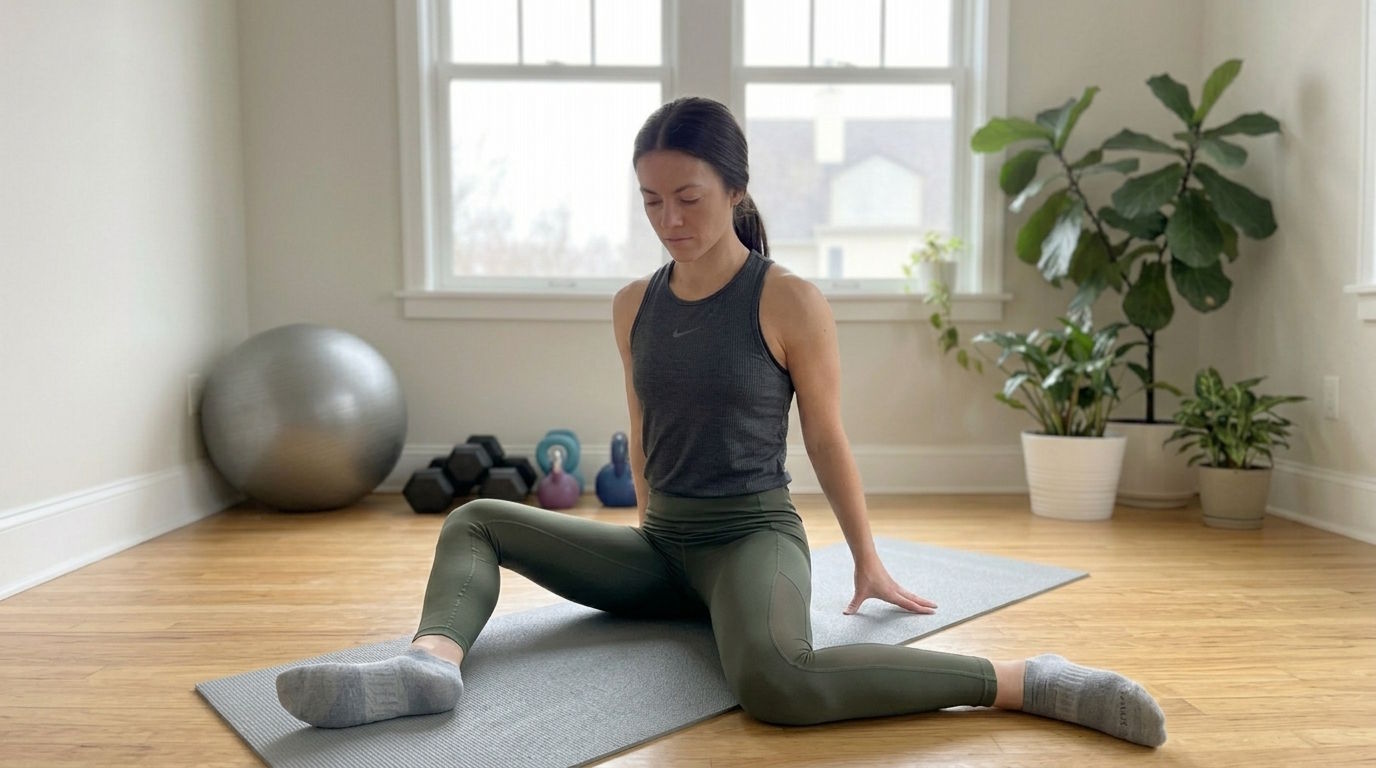
- 90/90 hip switches. Sit on the floor with both knees bent to about 90 degrees, one leg in front of you and the other off to the side. Rotate your knees across to the other side, then back. Use your hands behind you for support if you need them. This works both internal and external hip rotation, and tight hips are one of the most common things we see. Do 6 to 8 each way.
- Knee-to-wall ankle rock. Stand facing a wall with one foot about a hand’s width from it. Without letting your heel lift, drive your knee forward to touch the wall. If that’s easy, move your foot back a little. Do 10 reps per side. If your ankles are stiff, squatting and stairs both feel harder than they should, and the knees and hips often end up compensating.
- Supported squat hold. Hold onto a doorframe or a sturdy table and sink into the deepest squat you comfortably can, heels down. Stay there for 20 to 30 seconds, gently shifting side to side. Repeat 3 times. You don’t need to get all the way down. Whatever depth you have today is where you start.
- Wall slides (shoulders). Stand with your back and forearms against a wall, elbows at shoulder height. Slide your arms up the wall as far as you can without your back arching or your ribs flaring out, then lower back down. Do 10 reps. If your shoulders feel crunchy or tight overhead, this is a good place to start.
 Making it stick
The best routine is the one you’ll actually do. Pick two or three of these and attach them to something you already do, like when the coffee’s on or right after brushing your teeth. Then add a drill or two as they become routine. Set a reminder to stand up and move every hour or so if you sit for most of the day, even for just 30 seconds. And don’t worry about perfect form or doing it “right.” Consistency matters more.
When to get a hand
Mobility drills are great for general stiffness, but they won’t fix everything. If you have pain that’s getting worse, a joint that feels blocked or catches, numbness or tingling, or stiffness following an injury, it’s worth having someone look at it. Sometimes what feels like a tight muscle is a strength problem, a movement-pattern issue, or something we’d want to treat differently. A physiotherapist can figure that out and tailor a program to you.
If you’d like help, or just want someone to check your technique on these, you can book online or give us a call at the clinic. We’re always happy to see how you move and help you keep doing it.
References
- Behm DG, Blazevich AJ, Kay AD, McHugh M. Acute effects of muscle stretching on physical performance, range of motion, and injury incidence in healthy active individuals: a systematic review. Appl Physiol Nutr Metab. 2016;41(1):1-11.
- Bull FC, Al-Ansari SS, Biddle S, et al. World Health Organization 2020 guidelines on physical activity and sedentary behaviour. Br J Sports Med. 2020;54(24):1451-1462.
- Ross R, Chaput JP, Giangregorio LM, et al. Canadian 24-Hour Movement Guidelines for Adults aged 18-64 years and Adults aged 65 years or older. Appl Physiol Nutr Metab. 2020;45(10 Suppl 2):S57-S102.